How to Graft a Citrus Tree? The Simple Method for Beginners
⚠️ Warning: Citrus trees grown from seeds usually do not produce fruits identical to the parent tree. Grafting is essential to obtain the exact desired fruit variety. Also, consider the hardiness of the rootstock based on your climate, as highlighted by Michel Dufau.
Step 11. Why graft your citrus trees? The budding technique, the simplest and most effective
Grafting is a horticultural technique that allows two plants to be joined to become one. For citrus, this means combining a desired fruit-bearing branch (the scion) with a robust root system (the rootstock). This process ensures you get the exact fruit variety you desire, as seedlings often produce trees with unpredictable fruit quality.
Michel Dufau, an expert from Artisans du Végétal, emphasizes that among the various grafting methods, budding (or dormant eye budding) is particularly well-suited for citrus. Its simplicity and high success rate make it ideal for amateur gardeners.
Other grafting techniques exist, such as whip-and-tongue grafting or cleft grafting. The choice depends on the vigor and thickness of your rootstock. For smaller, pencil-sized rootstocks as recommended here, budding or whip-and-tongue grafting are ideal.
Step 22. What type of rootstock to choose and at what stage?
The choice of rootstock is crucial not only for compatibility with the scion, but also for the grafted plant's resistance to cold and specific soil conditions. Michel Dufau highlights two classic citrus rootstocks:
| Rootstock Type | Botanical Name | Key Characteristics | Cold Resistance | Soil Preference |
|---|---|---|---|---|
| Volkamer Lemon | Citrus volkameriana | Very vigorous, excellent compatibility with lemon trees. | Resistant down to -7 to -8 °C. | Prefers well-drained, slightly acidic soils; less tolerant of limestone. |
| Poncirus trifoliata | Poncirus trifoliata | Slower growth, but offers superior fruit quality and excellent cold resistance. | Extremely hardy, resistant down to -20 °C. | Very tolerant of limestone and heavier soils. |
Choosing between these two depends on your climate and desired fruit characteristics. If you live in a colder region, Poncirus trifoliata offers better frost protection. For warmer climates and vigorous growth, Citrus volkameriana is an excellent choice, especially for lemon trees.
Your rootstock should be between 18 and 24 months old and have a stem about the size of a pencil (approximately 6 to 8 mm in diameter) to be ready for grafting.
Step 33. How to prepare your rootstock: from seed to ready-to-graft plant
Before you can begin grafting, you need a healthy, well-developed rootstock. Follow these steps to prepare it:
Seed selection and sowing
Start by selecting seeds from the desired citrus fruit. The most commonly used rootstock for its vigor and compatibility is Citrus aurantium, or sour orange.
- Extract seeds from a ripe fruit.
- Sow them immediately in a light substrate.
Substrate preparation
A light, well-draining substrate is crucial for good root development, promoting healthier and faster growth.
- Mix peat and sand.
- Use a ratio of 60-70% peat and 30-40% pure sand for optimal aeration.
Sowing and initial growth
Gently place the seeds on the surface of the substrate and cover them lightly to provide the necessary conditions for germination.
- Cover the seeds with about 1 to 1.5 times their volume of substrate.
- Water abundantly after sowing.
- Wait for seedlings to emerge between 1.5 and 2 months.
Repotting and maturation
Once seedlings are established, repot them individually to allow for continued growth and development into suitable rootstocks.
- Repot individual seedlings into small pots.
- Let the plants grow for 18 to 24 months.
- The stem should be approximately pencil-sized (6-8 mm in diameter) at the time of grafting.
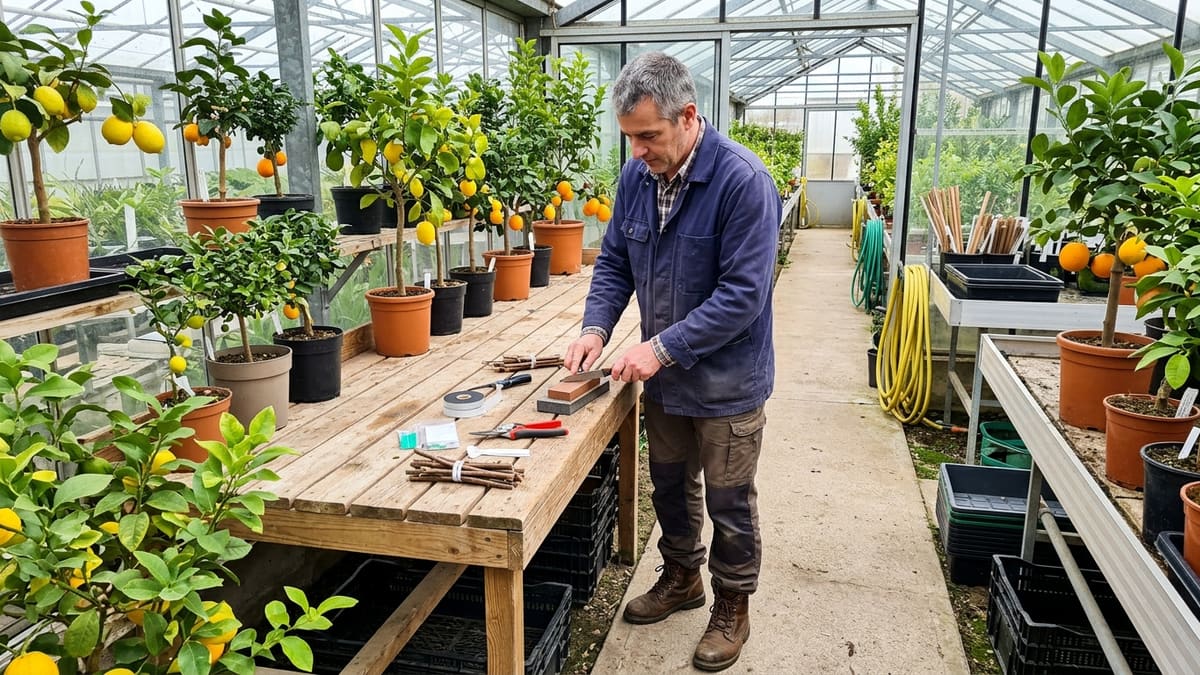
Step 44. What tools are needed and how to prepare them?
Having the right tools and preparing them correctly is essential for clean cuts and preventing disease transmission, significantly increasing your grafting success rate. Here's what you'll need:
- Pruning shears: Used for general pruning and initial scion cutting.
- Grafting knife: A specialized knife with a very sharp blade for precise incisions and a spatula on the back for lifting the bark. Ensure it is perfectly sharpened.
- Sharpening stone: Crucial for keeping your grafting knife razor sharp. A dull blade will tear plant tissues, preventing healing.
- Grafting tape: A flexible, self-adhesive tape used to secure the graft union and protect it from drying out and pathogens.
- Water container: To keep your scions hydrated before grafting.
Disinfection tip: Always clean and disinfect your tools before and after each graft to prevent the spread of diseases. You can use rubbing alcohol or a diluted bleach solution. Sharpening is key; never use a dull blade, as it would crush the cambium layer, which is vital for graft fusion.
Step 55. How to perform budding step-by-step?
Budding is a precise technique that requires careful execution. Follow these steps for success:
Prepare the rootstock
The rootstock must be clean and cleared of low leaves or branches to create a clear working area for grafting.
- Remove all leaves and small branches from the lower part of the rootstock for about 10-15 cm.
- Ensure the rootstock stem is firm and healthy.
Select the scion
Choose a healthy, woody branch from the desired citrus variety to ensure the scion has enough stored energy for successful growth.
- Select a woody, mature branch (not a young shoot).
- Remove all leaves from the scion, leaving only a small petiole (leaf stem) at the base of each bud (eye).
- Keep the scion hydrated in a small container of water until grafting.
Make the T-incision on the rootstock
The T-shaped incision allows for the insertion of the bud, ensuring good contact between the cambium layers of the rootstock and scion.
- With a grafting knife, make a vertical cut about 2-3 cm long on the rootstock stem.
- Then, make a horizontal cut at the top of the vertical cut, forming a 'T'.
- Gently peel back the bark flaps using the spatula of the grafting knife.
Extract the bud from the scion
Precision is essential when removing the bud, ensuring the integrity of the cambium layer for a successful union.
- On the selected scion, make a horizontal cut about 1 cm below a healthy bud.
- Then, make an upward cut, passing under the bud and stopping about 1 cm above it, creating a shield-shaped piece of bark containing the bud.
- Ensure the bud is not 'blind' (i.e., it has a growth point). If the woody part of the scion detaches easily from the bark, it's a good sign.
Insert the bud from the scion
Gently slide the bud into the T-incision of the rootstock, ensuring the cambium layers align perfectly.
- Gently slide the bud into the T-incision of the rootstock.
- Push it down until the top edge of the bud shield is level with the horizontal cut of the 'T'.
- Trim any excess bark from the bud shield if it protrudes too much.
Secure the graft
Firmly tying the graft with tape protects the union and promotes healing, preventing moisture loss and pathogen entry.
- Firmly wrap the graft with grafting tape, covering all incised areas.
- Ensure only the bud remains exposed.
- Tie a small knot to secure the tape.
Step 66. What is the best time of year to graft citrus trees?
The timing of grafting significantly influences its success. For citrus, the optimal period is in spring, specifically April. At this time, the plant's sap is actively flowing, which allows the bark to separate easily from the wood. This condition, known as 'bark slip', is essential for successfully inserting the bud into the T-incision of the rootstock. Grafting during this period gives the plant ample time to heal and the scion to establish before colder temperatures arrive. It is possible to graft until June or July, but the chances of success decrease.
Step 77. How to care for the plant after grafting to ensure success?
Once grafting is done, proper care is crucial for the scion to take and develop. Here's how to ensure the best chances of success:
Monitor the graft
Keep a close eye on your grafted plant for any signs of growth or problems, as the scion should start showing activity within a few weeks.
- Observe for new shoots emerging from the exposed bud.
- Growth typically appears within 2 to 4 weeks.
- Keep the plant in a bright location but out of direct sunlight, at a constant temperature of about 20-22°C.
Prune the rootstock
Once the scion shows significant growth, prune the rootstock to direct all energy towards the new variety.
- When the scion shoot reaches approximately 2 cm, prune the rootstock stem just above the graft union.
- This encourages the scion to become the dominant part of the plant.
- Remove the grafting tape after 2 to 3 months if the bud has taken and the scar is well formed.
Repotting and continued growth
As the plant grows, it will need larger containers to support its development, leading to a mature and fruiting tree.
- Repot the young grafted tree into a larger container as it grows.
- Within one year, the grafted plant will resemble a young tree.
- After approximately three years, the plant will be ready to be planted in the ground or grown in a permanent pot.
Step 88. Is it possible to graft any citrus on any citrus rootstock?
Generally, most citrus fruits are compatible with each other. You can graft a lemon tree onto an orange tree, a mandarin tree onto a Poncirus trifoliata rootstock, etc. Compatibility is rarely a major issue within the citrus family (genus Citrus and related genera like Poncirus or Fortunella). However, the choice of rootstock will significantly influence:
- Tree vigor: Some rootstocks produce larger and more productive trees than others.
- Disease and pest resistance: Some rootstocks are resistant to specific soil diseases, such as tristeza or gummosis.
- Soil adaptation: The rootstock can influence the tree's tolerance to limestone, humidity, or soil salinity.
- Cold resistance: As mentioned earlier, Poncirus trifoliata confers excellent hardiness.
- Fruit quality: The rootstock can slightly influence the size, sugar content, or acidity of the fruits.
It is therefore essential to choose a rootstock adapted to your climate, soil, and desired characteristics for the scion, rather than simply relying on biological compatibility.
Step 99. What are the signs of grafting success or failure?
Understanding the signs of a successful or failed graft will help you react quickly and make necessary adjustments.
Signs of success:
- Bud swelling and breaking: The most obvious sign is when the bud of your scion begins to swell and new shoots (often called 'furrow' in horticulture) begin to emerge, usually within 2 to 4 weeks after grafting.
- Green and turgid scion: The bud remains green and firm. If it appears withered or discolored, it may indicate a problem.
- Callus formation: Over time, you may observe the formation of healing tissue (callus) at the graft union, indicating that the vascular systems of the scion and rootstock are fusing.
Signs of failure:
- Blackened or dried scion: If the bud blackens, shrivels, or dries out, the graft has likely failed.
- Bud drop: The dropping of the bud is a clear sign that the graft has not taken.
- Lack of growth: After several weeks, if no signs of swelling or new growth appear from the bud, it is an indication of failure.
- Rootstock regrowth: If vigorous shoots develop from the rootstock below the graft union, the plant is directing its energy towards its original growth rather than the bud. In this case, cut off the rootstock shoots to encourage the scion.
If your first graft fails, don't be discouraged! Grafting often requires practice. You can usually attempt another graft on the same rootstock in a different location, provided the rootstock remains healthy.