Successful Fig Tree Air Layering: 5 Simple & Fast Steps
What is Air Layering and Why is it Suitable for Fig Trees?
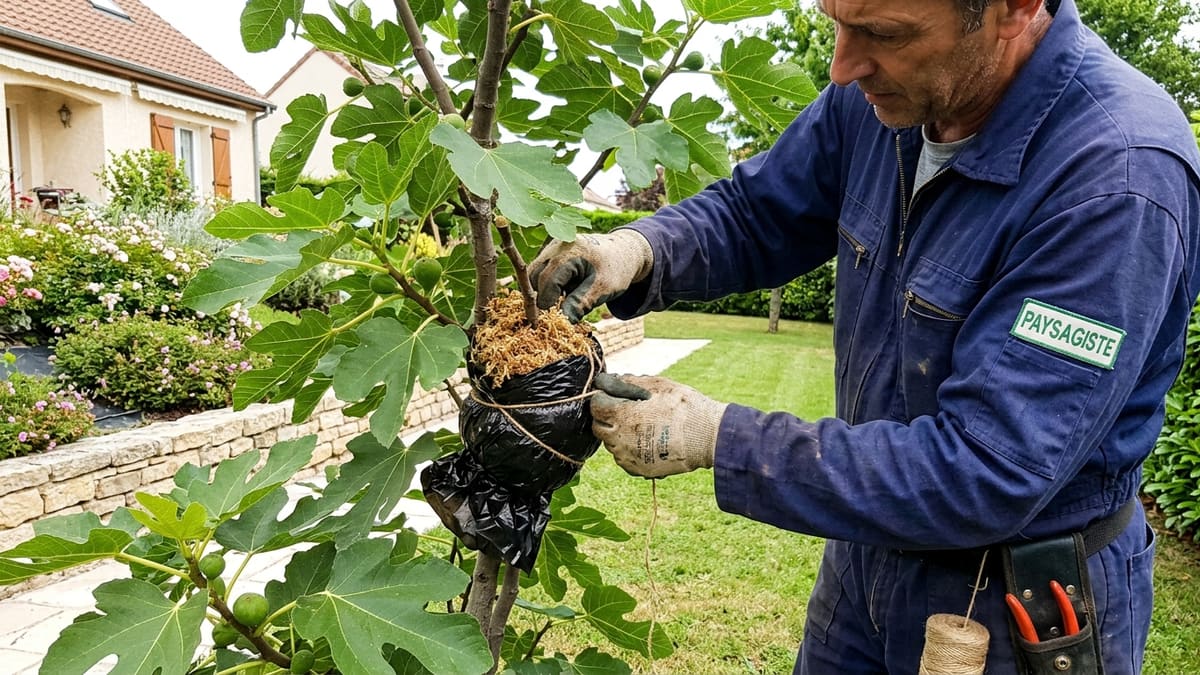
Air layering is a horticultural technique that allows a branch to root directly on the mother tree before being separated to become a new autonomous plant. Unlike traditional cuttings, where the cutting is separated and then attempted to be rooted, air layering maintains the vital link with the mother plant, ensuring a continuous supply of raw sap.
This method is particularly effective for the fig tree due to its exceptional ability to produce adventitious roots. Air layering guarantees a nearly perfect success rate (close to 100%), far surpassing the performance of traditional cuttings, which can be less reliable.
The principle involves creating an interruption in the circulation of elaborated sap (produced by the leaves and descending to the roots) while allowing raw sap (water and minerals rising from the roots) to circulate normally. This accumulation of elaborated sap at the interruption stimulates the formation of new roots, allowing a branch to be transformed into an independent, rooted plant.
What are the Advantages of Air Layering Compared to Fig Tree Cuttings?
For gardeners wishing to multiply their fig tree, air layering offers significant benefits compared to cuttings:
- Success rate close to 100%: This is the major asset. Permanent contact with the mother plant ensures hydration and nutrients, minimizing failures often encountered with cuttings.
- Rapid obtaining of large specimens: Air layering allows much thicker and more mature branches to root than those used for cuttings. You thus obtain a new, already developed fig tree that will produce fruit more quickly.
- Less stress for the young plant: The plant rooted on the mother tree is less disturbed during separation and transplantation, which promotes better recovery.
These advantages make air layering the preferred method for those who wish to reliably and efficiently multiply their fig tree, quickly obtaining vigorous plants.
Step 1What equipment is needed to perform air layering on a fig tree?
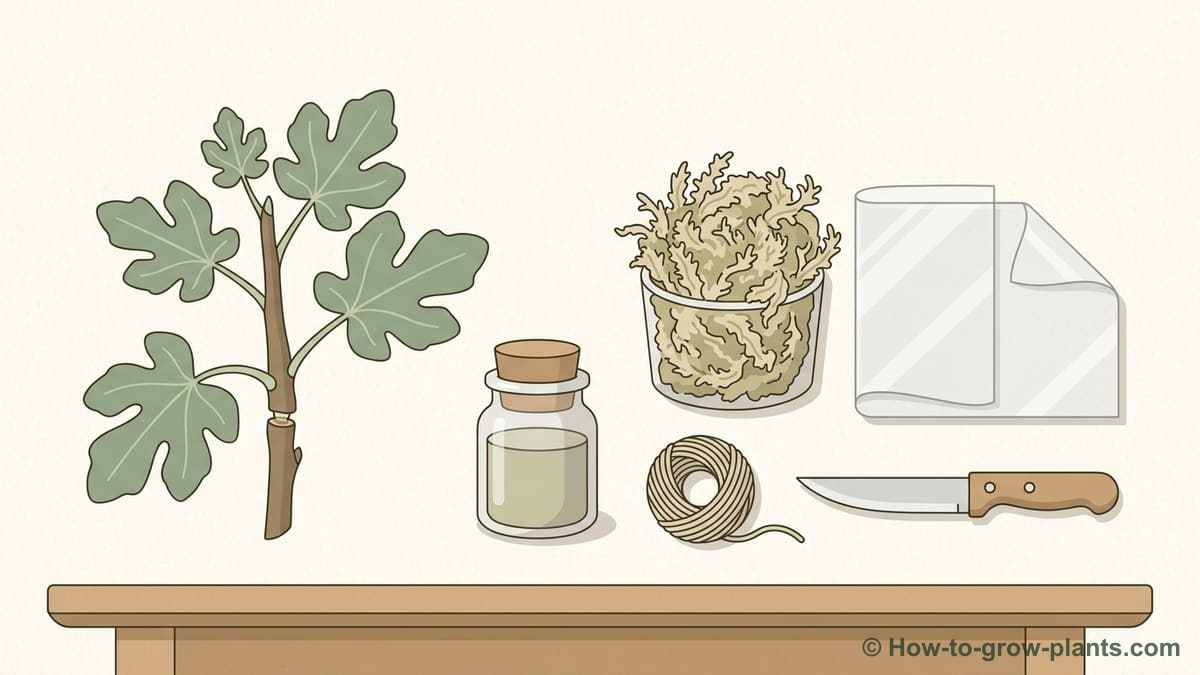
To successfully air layer your fig tree, gather the following materials, as presented in the video:
A split grow pot or a plastic bag
Use a large split plastic pot (nursery type) or an opaque plastic bag (like a 5-liter trash bag) to contain the substrate around the branch.
- A split pot is ideal for large branches. Cut it so it can be closed around the branch.
- A plastic bag, preferably black or opaque, helps maintain darkness and humidity.
A sharp knife or scalpel
Essential for making a clean and precise incision on the branch's bark.
- A clean, sharp blade minimizes damage and promotes healing and rooting.
- Avoid dull tools that tear the bark.
Good garden soil
Fill your container with fertile, well-draining garden soil.
- The soil must be rich enough to promote root development.
- Good moisture retention is crucial.
Wire, twine, or strong adhesive tape
To securely attach the pot or bag around the branch.
- Ensure the tie is weather-resistant and holds the container firmly in place.
- It should not constrict the branch.
Cardboard pieces (for mulching)
Use cardboard pieces to mulch the surface of the substrate in the pot.
- Mulching helps maintain consistent soil moisture, essential for rooting.
- It also prevents weed growth in the pot.
Step 2What are the precise and detailed steps to perform air layering on a fig tree?
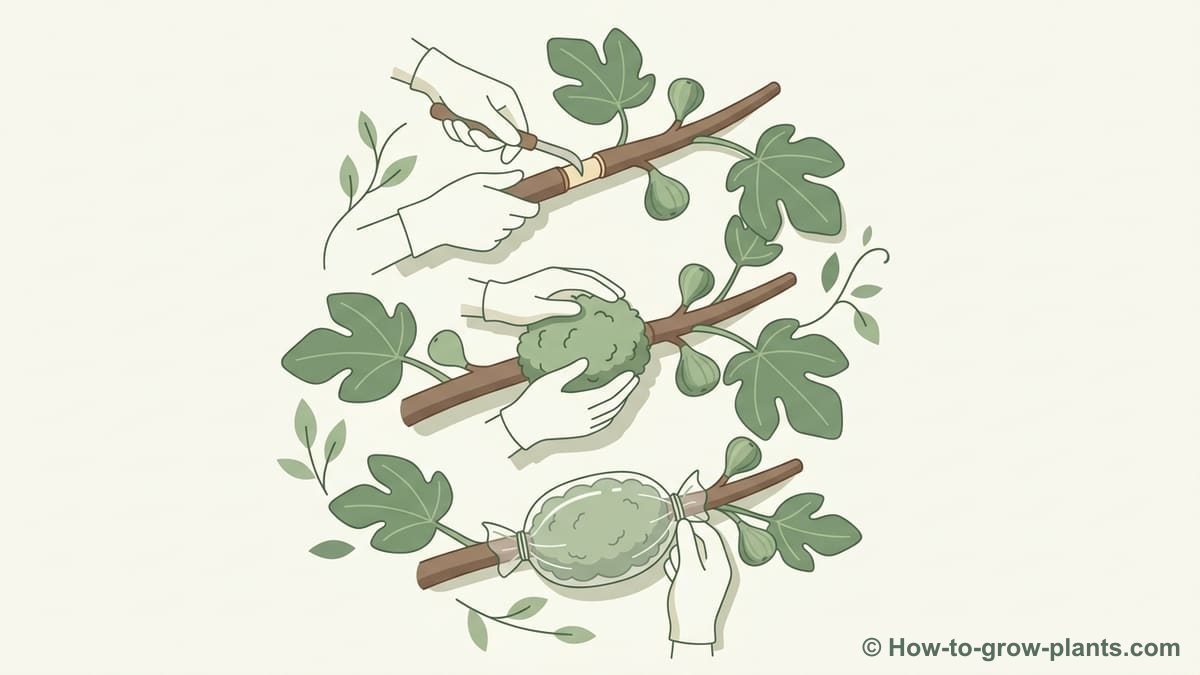
Follow these instructions for successful fig tree air layering:
Prepare the pot or bag
Adapt your container so it can surround the chosen branch.
- For a pot: Cut a hole in the bottom of the pot, slightly larger than the branch's diameter. Then split the pot vertically from top to bottom to open it in half.
- For a bag: Prepare the bag by opening it so it can be secured around the branch.
Choose and incise the branch
Select a healthy, vigorous branch and make a precise incision.
- Using the sharp knife, remove a 2 cm wide strip of bark all around the branch.
- Ensure the incision is clean, deep enough to the cambium (the layer under the bark), but without damaging the central wood.
- This bark removal blocks the descent of elaborated sap, stimulating root formation just above the cut.
Position the container and fill with soil
Gently place the split pot or bag around the incised area and fill with substrate.
- Open the pot or bag and position it around the incised part of the branch.
- Securely attach the container using wire, adhesive tape, or zip ties to prevent it from opening.
- Fill the pot or bag with good garden soil, making sure to cover the incised area well.
- Firmly pack the soil around the branch to eliminate air pockets and ensure good contact.
Water and mulch
Water abundantly and mulch to maintain consistent humidity.
- Water the soil generously until saturated, and until water drains from the bottom (if the container allows).
- Immediately cover the soil surface with cardboard pieces. This mulching is essential to retain moisture and prevent rapid drying of the substrate.
Step 3When is the best time of year to air layer a fig tree?

The ideal time to air layer your fig tree is in late autumn or early spring.
- Late autumn: Performing air layering at this time allows roots to develop slowly during winter. The following spring (April-May), the new plant will have a sufficiently robust root system to be separated. This is the recommended natural cycle for minimal stress.
- Early spring: If autumn was missed, early spring is a viable alternative. Sap rise and increasing temperatures promote faster rooting, often within a few months.
The La Clé des Champs video shows air layering performed in autumn, with weaning planned around April or May.
Step 4How to know when the air layer is sufficiently rooted and ready to be separated from the mother plant?
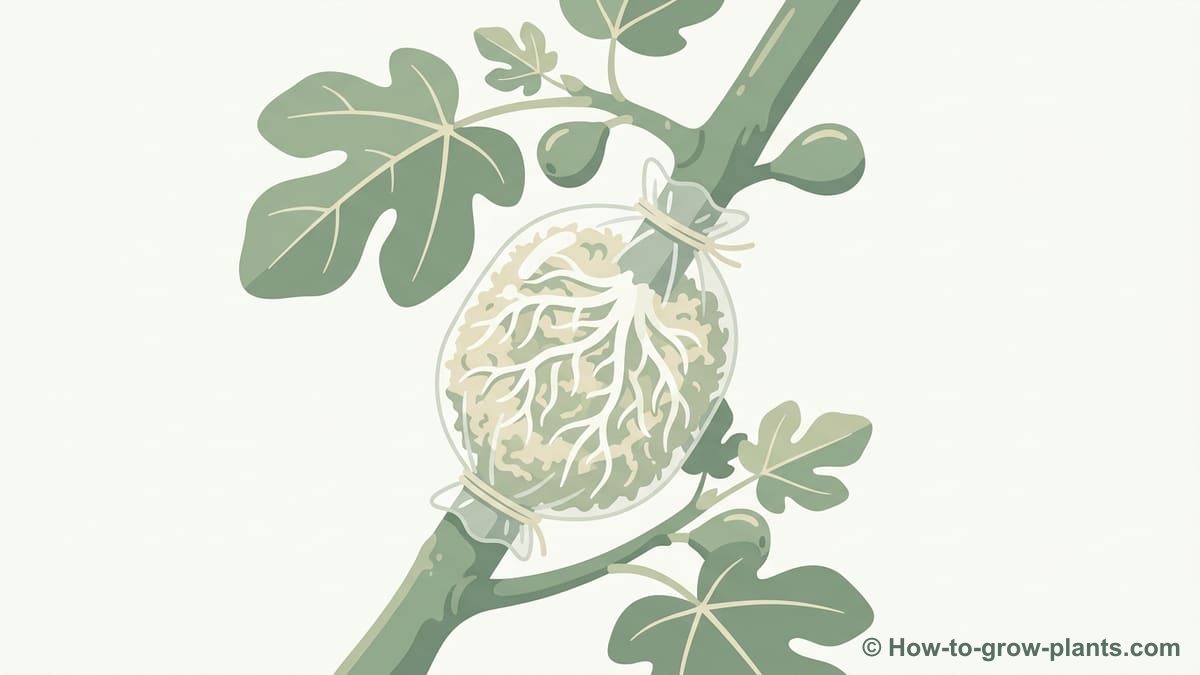
The critical moment to separate the air layer is when it has developed an autonomous and vigorous root system. For air layering performed in autumn, allow approximately 6 months, with separation planned for April or May of the following year.
The indicators are as follows:
- Visible roots: If you are using a transparent container, you should see a dense network of white or light roots forming and coiling inside the pot or bag. This is the most reliable sign.
- Firm root ball: For opaque containers, you can feel the pot; a firm sensation indicates a good root mass. Avoid disturbing developing roots.
- New foliage growth: Although less direct, vigorous new growth on the air-layered branch can indicate that the root system is ready to support it independently.
As soon as these signs are observed, the air layer is ready for weaning and transplanting.
Step 5How to care for the young air layer after separation to ensure its establishment?

Once your new air layer is separated from the mother tree, post-separation care is crucial to ensure its establishment and healthy growth:
- Clean cut: Use clean, sharp pruning shears to cut the branch just below the formed root ball. Make a clean, decisive cut.
- Initial transplanting: Immediately plant your young fig tree in a slightly larger pot or directly in its final garden location. Make sure to use well-draining soil rich in organic matter.
- Watering: Water generously after transplanting. For the first few weeks, keep the soil consistently moist, but never waterlogged, to encourage root establishment.
- Protection: Provide initial protection against intense direct sunlight or strong winds, especially if transplanting takes place in an exposed area. A temporary shade cloth can be beneficial.
- Mulching: Continue to mulch the base of the young fig tree to retain soil moisture and regulate its temperature.
With this attentive care, your new fig tree will thrive and become a productive fruit tree.
Step 6Can very large fig tree branches be air layered, and if so, how?
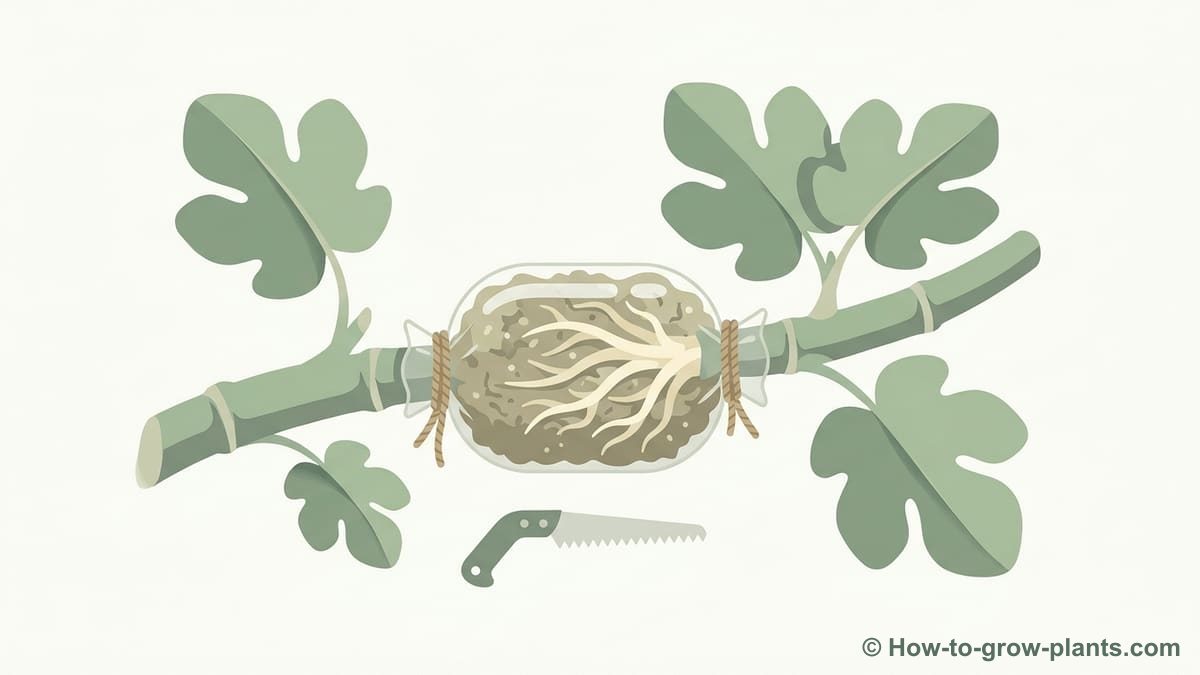
Yes, one of the most remarkable advantages of air layering, as highlighted by the video, is the ability to propagate very large fig tree branches. Unlike cuttings where branch size is limited, air layering places virtually no restrictions on the diameter of the branch you can root.
This allows you to:
- Obtain mature plants instantly: By air layering a thick, already well-developed branch, you create an almost adult tree, thus avoiding years of growth.
- Preserve specific structures: If a branch has a particular shape or is already producing fruit, you can replicate it directly.
- Maximize genetic material: This is ideal for gardeners who want to quickly multiply their favorite fig tree with large, identical specimens.
The technique remains the same, even for large branches: a clean 2 cm incision, good substrate in a secure container, consistent humidity, and patience. You may need to use a larger and more robust container (like a split 20-liter jerry can) and stronger ties to support the weight of the soil and branch.
By following these detailed steps, you can successfully multiply your favorite fig trees and enrich your garden with healthy, well-established plants. Air layering is a rewarding technique that guarantees excellent results.
💡 Expert Gardener's Tip
To deepen your knowledge of air layering and other plant propagation techniques, consult recognized references such as the Royal Horticultural Society (RHS) or INRAE in France.
Frequently asked questions
What is the best time for fig tree air layering?
The optimal period is late autumn, allowing roots to develop during winter for separation in April or May. Early spring is also a good time.
How long does it take for a fig tree air layer to root?
It takes approximately 6 months for a fig tree air layer to develop a sufficient root system. If done in autumn, it will be ready for separation in April or May of the following year.
Can very large fig tree branches be air layered?
Yes, air layering allows very large fig tree branches to root, offering the advantage of quickly obtaining new, already mature trees. You simply need to adapt the size of the container (e.g., a split 20-liter jerry can) and use strong ties.
What type of soil should be used for air layering?
Use good garden soil, fertile and well-draining, but capable of retaining moisture. Adding compost is beneficial to enrich the substrate and stimulate root development. Sphagnum moss is also an excellent option.
What is the success rate of fig tree air layering?
Fig tree air layering offers an exceptional success rate, close to 100%, making it a very reliable propagation method compared to traditional cuttings.